Organic Compounds:
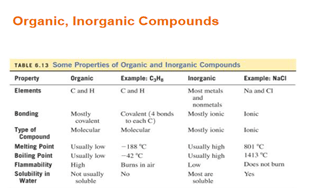
Carbon has a special role because many carbon atoms can bond together to create many types of molecular compounds. (Bonding in ALMOST all of them is covalent)
Organic compounds: Always contain carbon and hydrogen, and sometimes oxygen, sulfur, nitrogen, phosphorous, or a halogen (SON PH). Simplest one is CH4.
Characteristics:
- Low melting and boiling points than inorganic compounds
- NOT soluble in water
- Less dense in water than inorganic compounds
- They are non-polar
- Bonding in ALMOST all of them is covalent
Ex of an organic compounds: vegetable oil
Rules for formulas of organic compounds
- Formulas are written with carbon first, followed by hydrogen or other elements.
- Carbon only forms covalent bonds and needs four of them.
Hydrocarbons are organic compounds that contain only carbon and hydrogen.
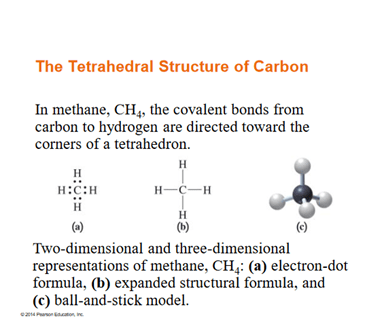
- In the electron-dot formulas for hydrocarbons, each shared pair of electrons represents a single covalent bond.
- Expanded structural formulas are drawn to show the bonds between all the atoms.
Note: *Saturated hydrocarbons contain only single carbon-carbon bonds.
H-C structure is tetrahedral.
 R's food blog